
Markerless Gait Analysis
Gait analysis.
No lab. No markers.
One iPhone.
Markerless gait and posture assessment for clinics that build custom insoles. Fifty parameters from a phone on a tripod, in the room you already have. No expensive equipment or installation needed.

Shape tells you the foot.
Function tells you the insole.
A 3D scan gives you geometry — length, width, arch height. It cannot tell you that the right foot collapses through stance and the left one doesn't. That difference is what the insole has to correct, and measuring it used to mean a gait lab.
Rearfoot
How far the heel everts through stance — left against right, in degrees.
Ankle
Whether dorsiflexion is actually available when the tibia passes over the foot, or the foot compensates for it.
Knee
Whether the knee tracks inside the foot under load.
Pelvis
Whether the pelvis drops on the swing side — the sign that what you see at the foot started above it.
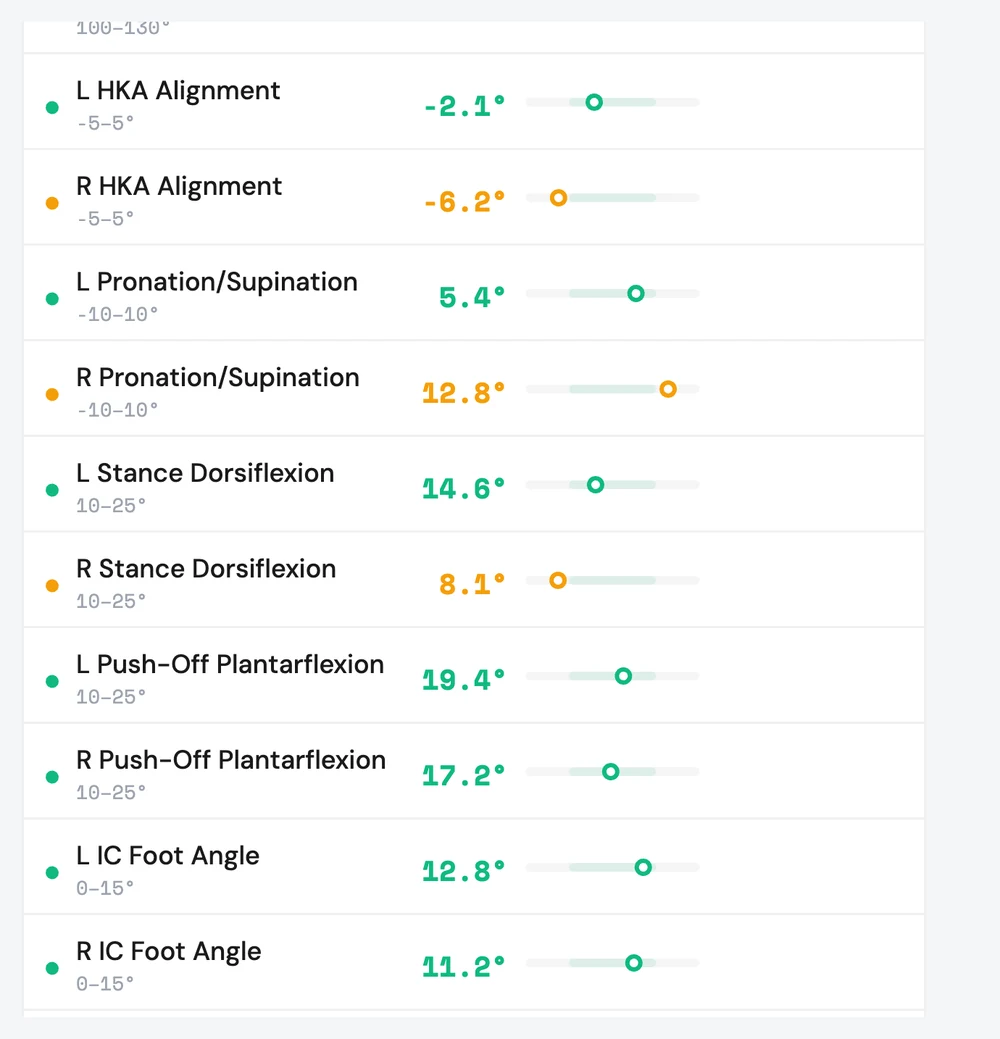
Right pronation 12.8° against left 5.4°. Same patient, same walk.
Already scanning with us? 3D Scanning → Same appointment, same phone, both halves.
What it measures
Rearfoot valgus / varus
Eversion through stance, left against right.
Foot progression
Toe-in or toe-out in degrees, not eyeballed.
Foot-strike pattern
Rearfoot, midfoot or forefoot at initial contact.
Ankle dorsiflexion in stance
Range available when the tibia passes over the foot.
Dynamic knee valgus
Frontal-plane knee travel under load.
Pelvic drop
Contralateral drop through swing — Trendelenburg.

Add a second phone. Get 3D.
One phone measures the plane it faces. Two phones set at right angles capture front and side at the same time — 3D measurement from two ordinary devices. No rig, no calibration frame, no markers.
Every measurement is tagged with the view it came from.
The tests your documentation already names
For clinics doing falls and mobility work: the standardized assessments, timed and counted automatically, written up against published reference thresholds before the patient has sat back down.
- Timed Up and Go
- 30-Second Sit-to-Stand
- Five-Times Sit-to-Stand
- 4-Stage Balance Test
- 10-Metre Walkcomfortable and fast pace
- Single-Leg Squatwith rep counting
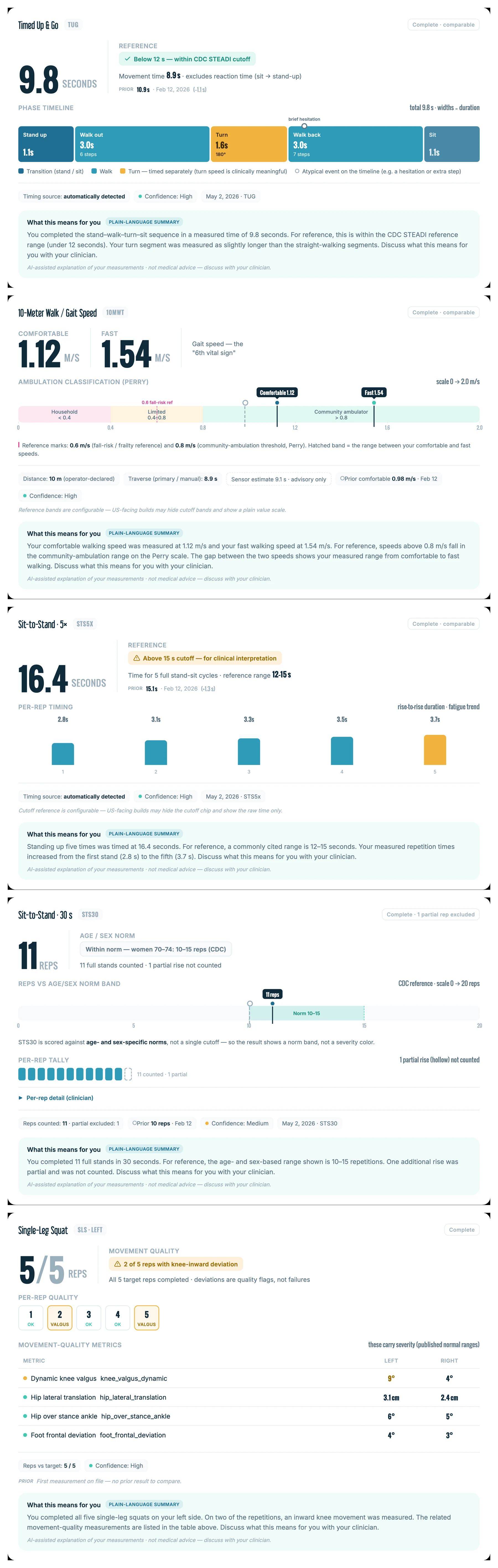
One test, shown in full. Click for all five.
What the patient leaves with
And what stays in the chart.
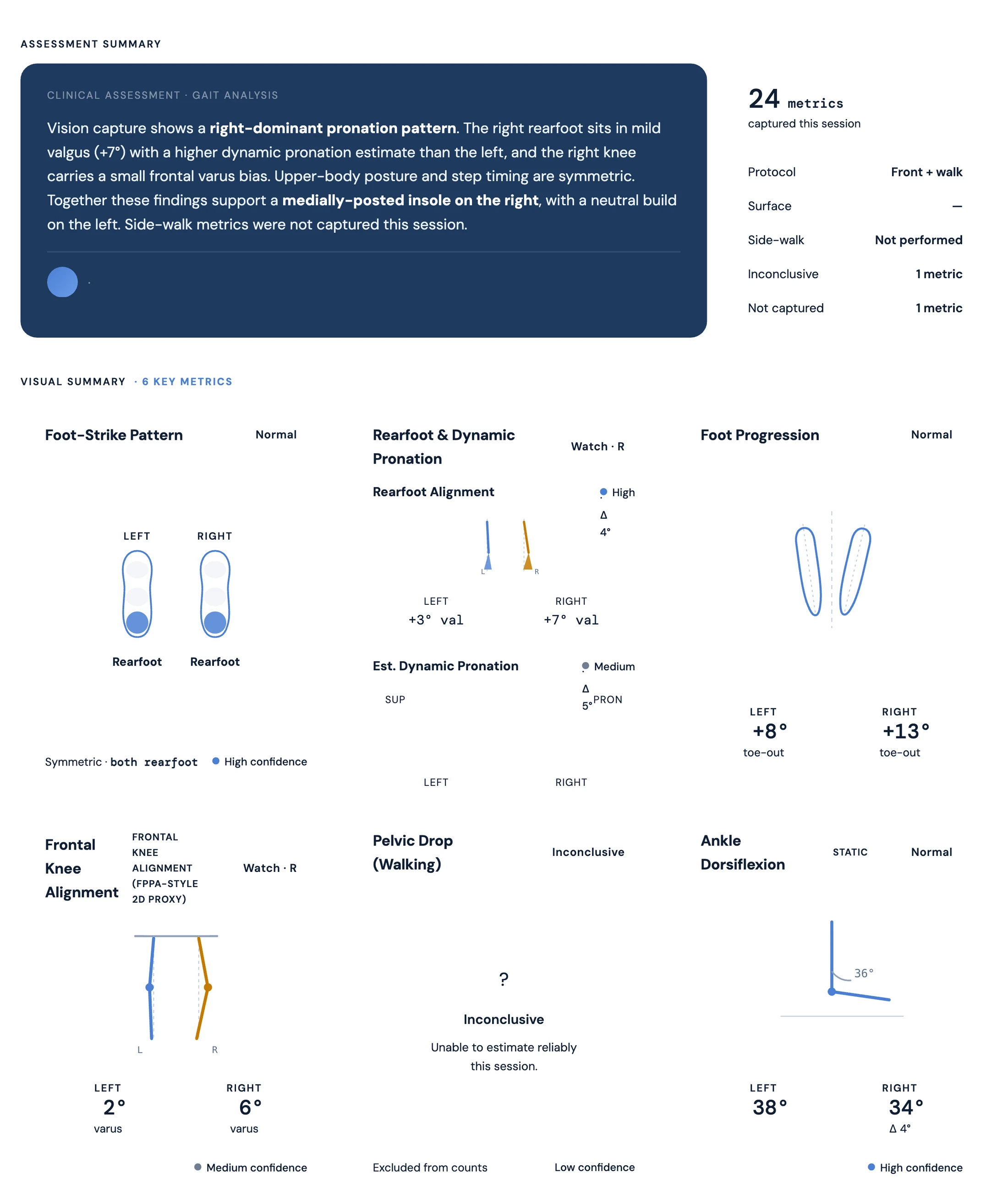
Every value against its reference range.
Left and right side by side — the asymmetry is the finding.
Findings and recommendations, written out.
Click to read the whole report.


Building a platform rather than running a clinic? The whole assessment runs under your brand, in your app, on your workflow. Talk to us →
Pay for what you use
No licence fee, no per-seat subscription, nothing to buy up front. Assessments run on credits — you top up, each assessment draws one, and the rate improves as your volume grows. A quiet month is a small bill.
Start with ten assessments.
Thirty days, free, on your own patients in your own rooms. We set up the protocol, you run it, and at the end you have your own data to judge it on.